Infiniteer: The Breakthrough in True Interactive Fiction
The First AI Generation: Fun Up Until the Wall
When AI happened, for a few years at least it looked like RPG hobbyists had been handed a miracle. Finally — a collaborator that could improvise. A dungeon master that never ran out of ideas. A bottomless story generator, or virtual companion.
The first generation of apps rushed in to exploit this. Character.AI let you chat with a persona. AI Dungeon let you freestyle through a text adventure. Replika sold AI companionship. SillyTavern handed power users a configurable frontend and told them to bring their own model and be their own prompt engineer. Several others. Each product, in its own way, proved the appetite was real: millions of people wanted AI to tell them stories, play characters, inhabit scenarios.
And each product, although fun for different audiences, ultimately hit the same wall.
Around turn 30 or 40, context windows strain. Memory drifts. A character who was cautious in act one becomes reckless in act two for no reason. The red scarf your companion was wearing disappears. The important promise they made gets forgotten. The world slowly deteriorates into a soft fog where anything can happen because nothing is really tracked reliably. There's a saying for it: "the AI is slipping again." It always slips.
The fundamental problem remains. Chat is not an interactive fiction system. A character card, however detailed, is not a plot. No amount of tuning gives you act structure, foreshadowing, payoff, or an ending. You get a conversation. After fifty turns, you are not fifty turns into a story. You are fifty turns into a chat that has been slowly forgetting itself the entire time.
This is why this first generation produced no novel-length engaging stories, or characters that held consistency and memory through 200 turns. And those are exactly the types of stories many of us want to experience.
Breaking the Context Barrier
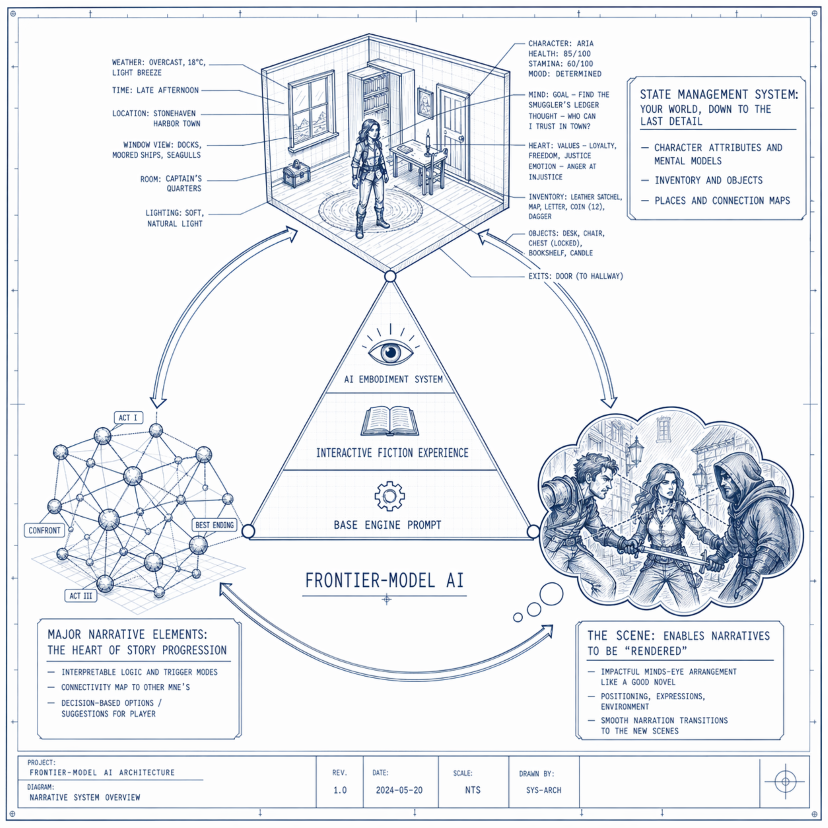
Infiniteer is built on a premise the first generation skipped over: every story needs a true supporting system — not just an AI — behind it. In Infiniteer, a human writer lays down the characters, the arc, the major beats, the endings, the moral texture. The AI's job is not to invent the story from scratch every turn. Its job is to bring an authored story to life, turn by turn, while a dedicated engine keeps everything that matters from slipping away.
That engine is where the real work is. Infiniteer has three systems, each of which does something no chat tool can do.
The Major Narrative Elements System
MNEs are the plot. They are pre-authored story moments — the first encounter with the pirate, the revelation about the dragon, the lighting project that banishes the supernatural darkness — that trigger when their conditions are met. Not when a model feels like it. When the author said they should.
This is how a story extends past a single prompt. The narrative isn't crammed into a system message that the AI half-remembers. It's a structured progression that the engine tracks independently. Hour six of your cave expedition can reference something that happened in hour one because hour one is still in state, waiting. The pirate's deal is still on the table. The lamp is still at 47% charge. The crown is still unearned. A character who made a promise in act one is still carrying it in act three.
This is the thing no character card can give you. Character cards are static descriptions. MNEs are a living plot.
The State Query System
Underneath every turn is a structured world. Characters have bodies, minds, memories, moods, inventories. Places have exits, contents, and descriptions. Objects have locations and attributes. When the Adventurer hangs his lamp on a hook near the well house door, that lamp is on that hook. When Kell Harmonde sets his whisky glass on the coffee table next to his date, the glass is on that table, and the fact that it's next to her is a tracked relationship with meaning.
Turn 100 can call back to turn 1 because turn 1 is still there, structured, queryable, durable. When a character needs to remember a conversation from four hours ago, the engine retrieves it. When the AI needs to describe a room, it's given the actual state of that room — including the coffee table, the glass, the date, everything. The AI doesn't have to remember. It just has to write what the engine puts in front of it.
This matters for consistency the way a foundation matters for a house. You don't notice it when it works. You notice it immediately when it doesn't.
The Scene System
Scenes are how the engine paints the picture. Every turn, the engine assembles the exact composition of what's in frame — which characters are present, what they're doing, where their hands and eyes are, what the environment feels like, what the focus is on. Major bodily positions are tracked. Gazes are tracked. Tensions are tracked. When the narrative describes a moment, it's describing something the engine has actually staged in response to the player.
The result is narrative prose that doesn't drift. Characters don't suddenly teleport across the room. They don't change clothes mid-conversation. They don't forget they were holding something. The little continuity details that the first generation of AI roleplay tools routinely broke — those details are the ones Infiniteer's scene system was designed from day one to protect.
What This Makes Possible
With these three systems working together, something new becomes possible: a story that stays with you for the length of a novel, not a chat session.
Consider Colossal, Infiniteer's adult homage to Crowther's original. It's designed for 25 to 35 choice points across four distinct ending paths. It includes a real-time lamp economy, a companion character whose relationship with the player evolves across acts, a dragon whose motivations are only revealed in act three, and an ecological solution that requires understanding and fixing a failed dwarven infrastructure project. None of that is possible in a chat wrapper. All of it is possible when the plot is authored, the world is stateful, and the scene is composed.
The same engine runs stories like Udorion's Fate, Hellbent, and When Light Bends Wrong, alongside others — The Binding Hour, Operation: Unsinkable, and The Stray — each with its own cast, its own stakes, its own endings the author committed to. You're not generating a story on the fly. You're reading a story someone envisioned end to end, that reads you back.
Make no mistake: a story can grow beyond its confines as needed. Locations can be extended. Characters can be introduced mid-story when the author calls for it, integrated cleanly into the state system without breaking what came before. The world can grow without losing itself.
Infiniteer is the breakthrough that true interactive fiction needs.
Ready to step inside an authored world that actually remembers you? Begin at infiniteer.com.
Previous: The Renaissance of Interactive Fiction: How Infiniteer Is Writing the Next Chapter